
New Earnings Safety Net for Helium Deployers
Introducing a minimum per-gigabyte earn rate for venue partners and deployers to protect against market downturns.
The Helium community recently passed HIP-149 and it’s one of the more comprehensive economic changes for the Network, including a key benefit for anyone deploying coverage: the notion of an earnings safety net.
A new target minimum for what deployers earn
Every deployment starts with someone who knows where connectivity falls short, whether the venue owner, the MSP, or an operator already running Wi-Fi on site. Deployers fill in the gaps where carriers can't build economically or feasibly. Carriers pay to route their subscriber traffic through Helium coverage, and deployers earn HNT tied to what carriers pay. Now, with the changes from HIP-149, there's an established rate with a target minimum regardless of how HNT moves in the market.
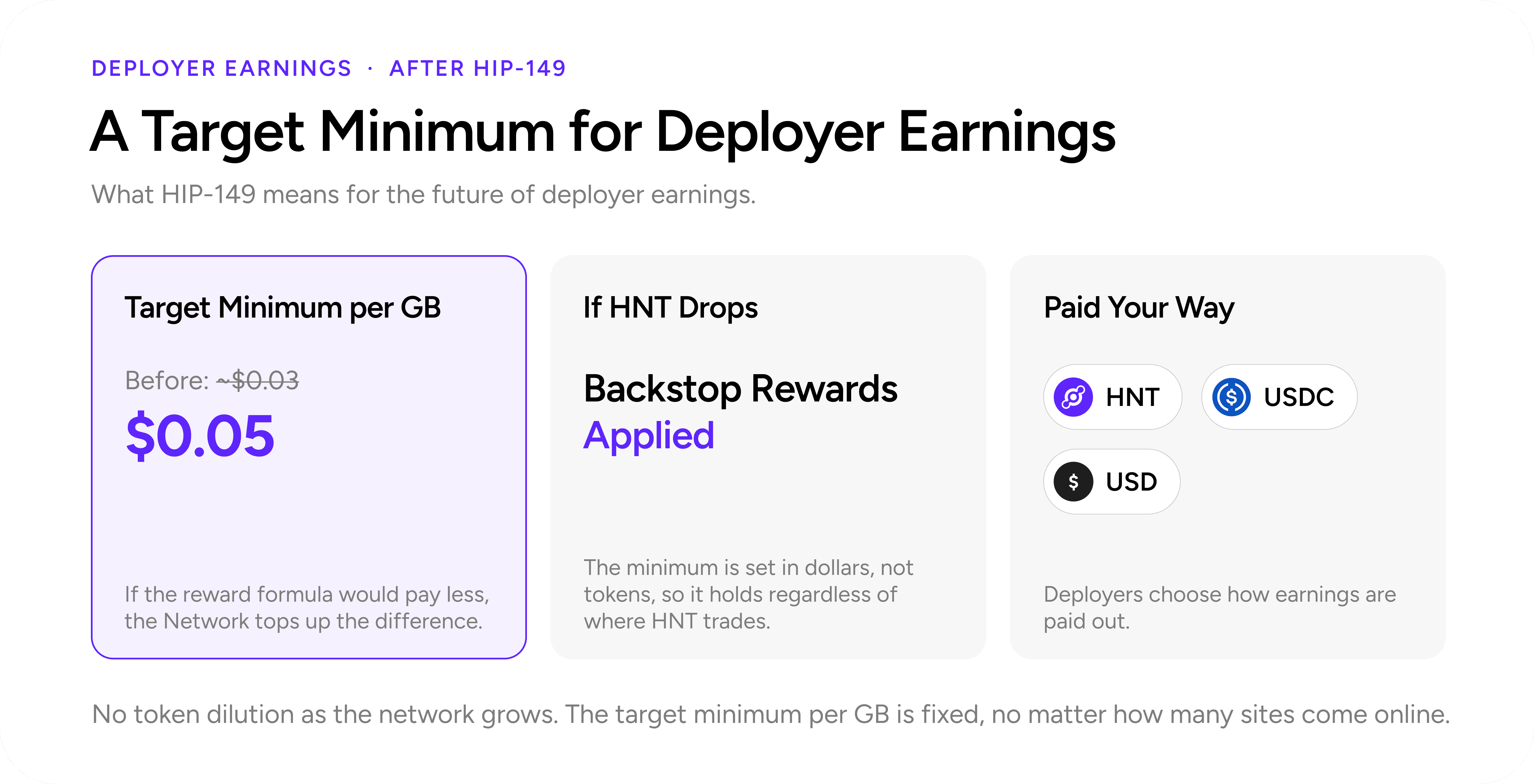
Today, based on current commercial rates, $0.05 is the target minimum a Helium deployer earns per gigabyte of data their sites carry, even if the price of HNT price drops. For new venues and sites, that floor turns earnings ambiguity into a number that can be planned against.
Here’s how the safety net works:
Deployers are paid from the Network’s regular daily rewards, which means the dollar value of those rewards moves with the HNT price. When the value falls below the $0.05 target, the protocol makes up the difference. It doesn’t print extra HNT, it re-emits a portion of the HNT that was already burned to pay for that same data, so the safety net adds nothing to the total supply. It simply recycles what the Network already earned.
On the upside, earnings climb with HNT's price all the way up to three times what carriers pay, $0.30/GB today. Beyond that, the excess flows to the Network's long-term stakers. Earnings maintain alignment to carrier revenue and that is what makes deployment income something a business can actually underwrite, with both ends of the range rising as commercial rates improve.
A few things worth knowing:
At the price of HNT as of the publishing of this article, this floor is already the thing keeping Helium deployer earnings up. Without it, earnings would be lower right now.
The minimum earnings are a target, not a bulletproof guarantee. If HNT's price drops fast, the top-up can lag for a week or two until enough recently-burned HNT is available to fully cover it.
The floor and the math behind it sit outside anyone's administrative discretion. Changing them takes a full Helium community vote.
Before HIP-149, deployers were earning closer to $0.03 per gigabyte. The protocol raises that minimum and ties it to USD, ensuring stability regardless of where HNT trades. On other offload networks, earnings are diluted as the network grows: more participants splitting the same pool means each deployer's share shrinks over time. Helium's floor works the opposite way, holding the minimum steady per gigabyte no matter how large the Network gets. As a reminder, Helium Plus deployers choose how they get paid: HNT, USDC, or USD.
The bottom line, HIP-149 adds an important safety net earning rate for venue partners and deployers of the Helium Network to ensure stability of coverage and stronger economics for the people building this Network.
To learn more about onboarding venues to the Helium Network, email the team at business@helium.com.


